
Introduction: Beyond the Gateway
In the grand tapestry of Tanzanian tourism, certain names resonate with the power of a drumbeat, echoing across the savannahs and into the imaginations of travelers worldwide. The Serengeti, with its endless plains and the thunderous spectacle of the Great Migration; the Ngorongoro Crater, a collapsed caldera teeming with life in a concentrated, breathtaking arena; and the majestic, snow-capped peak of Mount Kilimanjaro, the roof of Africa. These are the titans, the undisputed headliners of East African safari lore. Yet, nestled in the shadow of these giants, often relegated to the status of a mere prelude or a convenient stopover, lies a destination of profound beauty, ecological diversity, and intimate adventure that demands to be experienced in its own right: Arusha National Park.
To label Arusha National Park simply as the “gateway” to the northern circuit is to misunderstand its essence entirely. It is not merely a corridor through which travelers pass en route to greater fame; it is a destination that encapsulates the very soul of Tanzanian landscapes in a single, accessible package. Within its 552 square kilometers (136,000 acres), a microcosm of East Africa’s ecological wonders unfolds. Here, the rugged, forested slopes of a towering volcano meet the serene, alkaline waters of shimmering lakes. Dense, montane rainforests give way to open, grassy glades, and a secluded, forested crater hides a world of its own. This remarkable condensation of habitats makes Arusha National Park not just a park, but a living textbook of geography, ecology, and conservation.
For the discerning traveler, the allure of Arusha lies in its contrast. It offers a safari experience that is less about the relentless pursuit of the “Big Five” and more about the appreciation of nuance, detail, and connection. It is a place where you can trade the dust of the open plains for the cool, damp air of a cloud forest; where the roar of a lion is replaced by the haunting call of a colobus monkey and the splash of a flamingo taking flight. It is a sanctuary for the senses, offering activities that are rare or non-existent in other major Tanzanian parks: guided walking safaris that reconnect you with the earth beneath your feet, and tranquil canoe excursions that allow you to glide silently across mirror-like lakes, immersed in a world of water and sky.
This comprehensive exploration aims to peel back the layers of Arusha National Park, moving beyond the superficial glance to reveal its heart and soul. We will journey through its distinct geographical zones, from the volcanic peaks to the lake shores. We will encounter its resident wildlife, celebrating the stars of the show that call this place home. We will delve into the unique experiences that define a visit here, providing practical wisdom for those planning an expedition. Furthermore, we will examine the critical conservation efforts that protect this fragile ecosystem and the community initiatives that ensure its benefits are shared. Arusha National Park is not an afterthought; it is an overture, a masterpiece in miniature, and a testament to the incredible diversity that makes Tanzania a premier global destination. To skip it is to miss a fundamental chapter in the story of East African wilderness.
Chapter 1: A Landscape Forged by Fire and Water
To truly appreciate Arusha National Park, one must first understand the geological forces that sculpted it. The park’s dramatic topography is a direct result of the East African Rift Valley’s tectonic activity and the region’s volcanic history. Dominating the entire landscape is Mount Meru, a stratovolcano that stands as a sentinel over the park and the city of Arusha itself. At 4,562 meters (14,968 feet), it is Tanzania’s second-highest peak, a majestic and often cloud-shrouded giant that serves as the park’s central anchor. Mount Meru is not merely a backdrop; it is an active geological entity. Its last significant eruption occurred in 1910, and its slopes bear the scars and gifts of that fiery past. The volcano’s conical shape is imperfect, with a large section of its eastern rim missing, a catastrophic collapse that occurred thousands of years ago. This collapse created the stunning semi-circular caldera that now houses the park’s lower slopes and the Momella Lakes.
The Momella Lakes are the park’s aquatic jewels, a series of seven shallow, alkaline lakes nestled on the northern slopes of Mount Meru. Their names—Small Momella, Large Momella, Tulusia, Digumede, Rishateni, Ngarenanyuki, and Kusare—whisper of the local Meru and Maasai heritage. These lakes are not fed by rivers but by underground springs that percolate through the volcanic rock of Mount Meru, emerging at the surface with a constant, cool flow. This unique hydrology means the lakes maintain relatively stable water levels year-round, though their surface area can fluctuate. The water is rich in minerals and supports dense populations of algae, which in turn attract vast flocks of flamingos, painting the shores in dynamic shades of pink that shift with the seasons and the algae blooms. The lakes are set against the breathtaking backdrop of Mount Meru’s forested slopes, creating a vista of such serene beauty that it feels almost staged, yet is entirely natural.
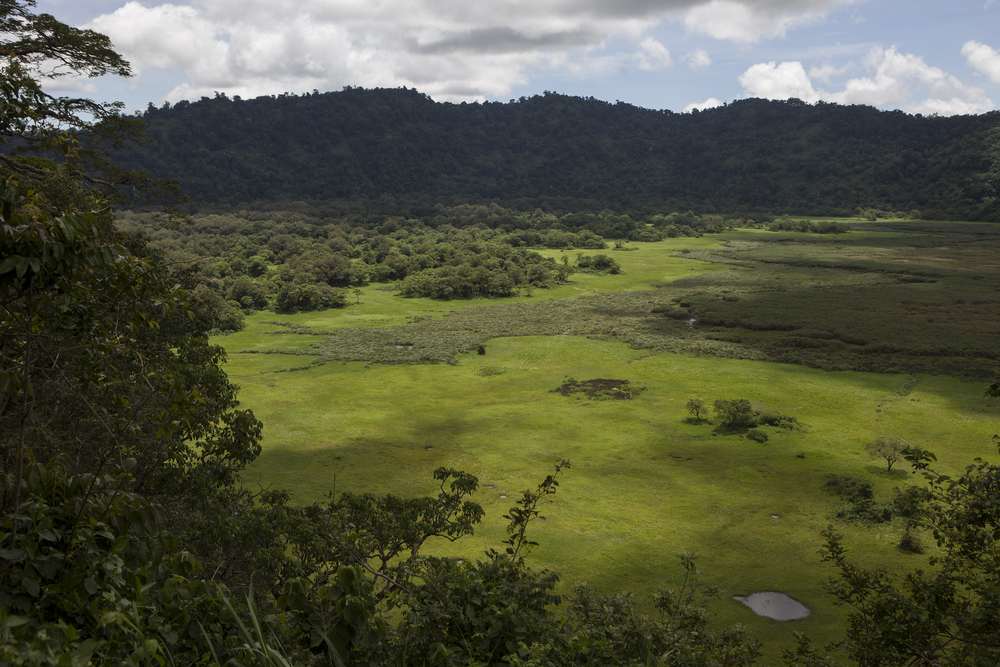
To the southeast of the Momella Lakes lies the Ngurdoto Crater, often affectionately dubbed “Little Ngorongoro.” This feature is a testament to the region’s volatile past. Ngurdoto is a small, steep-walled crater, approximately 3 kilometers in diameter, formed by the collapse of a volcano long extinct. Its walls rise sharply from the crater floor, creating a natural enclosure that has fostered a unique and isolated ecosystem. The floor of Ngurdoto is a mosaic of swampy grasslands, freshwater marshes, and patches of dense forest, fed by several small streams that cascade down the crater walls. Unlike the open plains of the Serengeti or the vast floor of Ngorongoro, Ngurdoto is intimate and enclosed. Its forested rim and floor create a habitat that favors different species, making it a haven for forest-dwelling animals and a paradise for birdwatchers. The crater is largely inaccessible to vehicles, preserving its wilderness character and allowing only aerial views or the perspectives of those lucky enough to hike along its rim, adding to its aura of mystery.
The park’s vegetation is a direct reflection of its altitude and geology, changing dramatically as one ascends the slopes of Mount Meru. At the lower elevations, around the Momella Lakes and the park headquarters, the landscape is characterized by open grassland and acacia woodland, typical of the East African savannah. As you move higher, the grasslands give way to dense, montane rainforest. This forest is a lush, dripping world of giant trees draped in moss and lichen, where sunlight filters through a thick canopy in dappled patterns. The air is cool and moist, filled with the sounds of birds and insects. Higher still, above the treeline at approximately 2,500 meters, the forest transitions into heathland and moorland. Here, the vegetation becomes more stunted and hardy, featuring giant lobelias and groundsels that look like plants from another planet, adapted to the cold, windy conditions. Finally, near the summit, the landscape becomes an alpine desert, a barren, rocky realm of scree and sparse, resilient vegetation. This vertical journey through distinct ecological zones, all within the confines of a single mountain, is one of Arusha National Park’s most compelling scientific and aesthetic features.
Chapter 2: The Residents of the Green Kingdom
While Arusha National Park may not boast the high density of lions or the iconic black rhinos that draw crowds to other parks, its wildlife roster is rich, specialized, and profoundly rewarding for those who observe with patience and attention. The park’s animals are perfectly adapted to its specific habitats, from the forested slopes to the lake shores and the crater floor.
The undisputed ambassadors of Arusha are the giraffes. Specifically, the park is home to the Masai giraffe, the tallest of all giraffe subspecies, identifiable by its large, jagged, vine-leaf-shaped spots that extend down its legs. In Arusha, giraffes are not a distant sighting on the horizon; they are constant, graceful companions. They browse on the acacia trees that dot the grasslands, their long necks allowing them to reach foliage unavailable to other herbivores. It is common to see them ambling along the park roads, their movements slow and deliberate, offering unparalleled opportunities for observation and photography. Their presence is a daily reminder of the park’s health and the success of its conservation efforts.
Another highlight, and a specialty of the montane forest, is the primate population. The dense, moist forests on the lower slopes of Mount Meru provide an ideal habitat for two species of monkeys: the black-and-white colobus and the blue monkey (also known as the Sykes’ monkey). The black-and-white colobus is a sight of ethereal beauty. With its striking黑白 coat, long, flowing white tail, and serene expression, it moves through the high canopy with acrobatic grace, leaping from branch to branch in search of leaves, its primary food source. Spotting a troop of colobus monkeys, their white tails flashing against the green foliage, is a magical experience. The blue monkey, with its darker, olive-green fur and expressive face, is more terrestrial and often heard before it is seen, with its distinctive loud, coughing calls echoing through the forest. Observing these intelligent primates in their natural habitat adds a layer of behavioral ecology to the safari experience that is deeply engaging.
The park’s grasslands and woodlands support healthy populations of other herbivores. The Cape buffalo is a common and impressive sight, often seen in large, formidable herds, especially near the Momella Lakes at dawn and dusk when they come to drink. Their dark, massive forms against the backdrop of Mount Meru create a powerful image. Waterbuck, with their distinctive white ring around the rump, are frequently seen grazing near water sources. The smaller, more elusive bushbuck can be spotted at the forest edge, while the tiny, endearing dik-dik, one of Africa’s smallest antelopes, darts through the underbrush. Warthogs are also common, their comical faces and upright tails making them a favorite among visitors.
While elephants are not resident in large numbers, they do occasionally wander into the park from the surrounding areas, particularly in the drier seasons. Their presence is always a thrilling and unpredictable event. Leopards, the elusive masters of camouflage, are known to inhabit the park’s forests, but sightings are rare and considered a stroke of great luck. The absence of lions and rhinos is a defining characteristic of Arusha, shaping the type of safari experience it offers. This lack of large predators means that game drives are generally more relaxed, with less pressure to “tick off” species and more opportunity to appreciate the smaller details of the ecosystem.
However, to speak of wildlife in Arusha without mentioning its birds is to tell only half the story. The park is an ornithological treasure trove, with over 400 species recorded. The Momella Lakes are the epicenter of this avian activity. Depending on the season and water levels, thousands of lesser and greater flamingos can be seen, their pink plumage creating a stunning contrast with the blue water and green shores. When they take flight in a synchronized cloud, the sound of their wings is a roar that fills the air. The lakes and their surrounding marshes are also home to a plethora of waterbirds: herons, egrets, storks, ibises, and kingfishers. The iconic African fish eagle, with its distinctive, haunting call, is often heard soaring above the lakes.
In the forests, the birdlife is equally diverse and specialized. The silvery-cheeked hornbill, with its large, curved casque and striking black-and-white plumage, is a common and charismatic resident. The vibrant Hartlaub’s turaco, a bird of brilliant green and red with a prominent crest, flashes through the canopy. Barbets, woodpeckers, sunbirds, and a variety of raptors, including the endangered African crowned eagle, which nests in the tall forest trees, complete the picture. For the birdwatcher, Arusha National Park is not a secondary destination; it is a primary pilgrimage site, offering a density and variety of species that is hard to match in such a compact area.
Chapter 3: Experiences That Define Arusha
What truly sets Arusha National Park apart from its more famous neighbors is the range of immersive activities it offers. While game drives are available and rewarding, the park’s unique regulations and landscape encourage a more active, intimate form of exploration.
The Walking Safari: Reconnecting with the Earth
In most of Tanzania’s major national parks, visitors are confined to their vehicles for safety reasons. Arusha National Park is a notable and welcome exception. Guided walking safaris are one of its signature experiences, offering a perspective that is fundamentally different from that of a car. Accompanied by a knowledgeable guide and an armed park ranger, visitors embark on trails that wind through the forest, along the edges of the Momella Lakes, or through the grasslands.
The sensation of walking through the wilderness is primal and profound. The engine noise vanishes, replaced by the symphony of the bush: the crunch of leaves underfoot, the chatter of monkeys, the songs of birds, and the rustle of unseen animals in the undergrowth. Your senses heighten. You notice the intricate patterns of spider webs glistening with dew, the variety of tracks in the mud, the scent of damp earth and flowering plants. A guide will point out medicinal plants, explain the signs of animal activity, and share insights into the delicate balance of the ecosystem. This is not a passive observation; it is an active engagement with the environment. It fosters a deeper understanding and appreciation for the wilderness, transforming the visitor from a spectator into a participant, albeit a respectful and cautious one. The presence of the armed ranger is a reassuring reminder of the wildness of the setting, adding a tangible thrill to the experience.
Canoeing on the Momella Lakes: A Silent Journey
If walking safaris bring you down to earth, canoeing on the Momella Lakes lifts you into a realm of tranquility and reflection. This activity is permitted on certain lakes, typically under strict guidance and with safety protocols in place. Paddling a canoe across the glassy, shallow waters at dawn is an experience of unparalleled serenity. The world is quiet, save for the dip of the paddle and the occasional call of a bird. The rising sun paints the sky in hues of orange and pink, which are mirrored perfectly in the still water, with the majestic silhouette of Mount Meru completing the panorama.
From this low vantage point, the perspective on wildlife is unique. You can glide past herds of buffalo drinking at the shore, observe waterbuck grazing in the reeds, and watch flocks of flamingos wading in the distance, all without disturbing them. Hippos are present in the lakes, and guides maintain a safe and respectful distance, often paddling around their territories. The silence of the canoe allows for close, undisturbed observation of birdlife; kingfishers dart from perches, fish eagles circle overhead, and the intricate behaviors of waterbirds unfold before you. This activity is not about adrenaline; it is about mindfulness, connection, and witnessing the park’s beauty in its most peaceful state. It is a meditative experience that often becomes the most cherished memory of a visit.
Climbing Mount Meru: The Ultimate Challenge
For the physically adventurous, Mount Meru presents a formidable and rewarding challenge. The climb to its summit, Socialism Peak, is typically a 3-4 day trek, following a well-established route that passes through the park’s diverse ecological zones. The ascent begins in the montane forest, where hikers are likely to encounter colobus monkeys and a wealth of birdlife. As they climb higher, the forest gives way to heathland, with its strange and beautiful giant lobelias and groundsels. The final push to the summit is a pre-dawn scramble over rocky terrain, culminating in a breathtaking sunrise view from the crater rim.
From the summit, on a clear day, the views are spectacular. You can look down into the Ash Cone, a smaller volcanic cone within the main crater, and across to the vast plains of the Serengeti. Most famously, you are rewarded with a panoramic view of Mount Kilimanjaro, Africa’s highest peak, standing alone on the horizon. The climb is physically demanding, requiring a good level of fitness, but it is less crowded and often considered more scenic than the initial stages of Kilimanjaro climbs. It serves as an excellent acclimatization trek for those planning to attempt Kilimanjaro, but it is also a magnificent achievement in its own right. The climb is fully supported by guides and porters, and hikers stay in basic mountain huts along the route. It is an adventure that combines physical exertion with stunning natural beauty and a profound sense of accomplishment.
Game Drives: The Classic Safari
Of course, the traditional game drive remains a core activity in Arusha National Park. The park’s road network, while not as extensive as in the Serengeti, provides good access to the key wildlife areas, particularly around the Momella Lakes and the foothills of Mount Meru. Morning and evening drives are the most productive, as animals are more active during the cooler hours. The drives here are often more relaxed and less congested than in the northern circuit’s flagship parks. You can spend time observing a family of giraffes without a queue of vehicles, or watch a buffalo herd move through the grasslands in peace. The variety of landscapes visible from the vehicle is remarkable, with the backdrop of Mount Meru providing a constant, stunning frame for every scene. For photographers, the light on the mountain at sunrise and sunset is exceptional, and the proximity to the animals allows for intimate shots. While you may not see a lion, the quality of the sightings you do have is often higher, with more time for observation and less pressure to move on.
Chapter 4: Planning Your Journey to Arusha
Visiting Arusha National Park is remarkably straightforward, thanks to its proximity to major transport hubs. This accessibility is one of its greatest assets, making it an ideal choice for a day trip, a one-night stopover, or a longer, more immersive visit.
Getting There and When to Go
The park’s main gate, the Ngurdoto Gate, is located approximately 25 kilometers (about 40 minutes’ drive) east of Arusha city. Kilimanjaro International Airport (JRO) is roughly 60 kilometers away, about an hour’s drive. This makes Arusha National Park the most accessible national park in Tanzania for international arrivals. You can easily visit the park on your arrival day or before your departure, maximizing your time in the country.
Arusha National Park is a year-round destination, but the experience varies with the seasons. Tanzania has two primary dry seasons and two wet seasons. The long dry season runs from June to October. This is generally considered the best time for wildlife viewing, as vegetation is thinner and animals congregate around permanent water sources like the Momella Lakes. The skies are clear, offering excellent views of Mount Meru, and the weather is pleasant, with cool mornings and warm days. This is also the peak tourist season for the northern circuit, so while Arusha is less crowded than Serengeti or Ngorongoro, booking in advance is still advisable.
The short dry season from late December to February is another excellent window. The weather is warm, and the landscapes are still green from the short rains. Birdwatching is particularly good during this time, as migratory species are present. The wet seasons, from March to May (the long rains) and November (the short rains), bring lush, green scenery and fewer visitors. The park is beautiful during this time, with waterfalls flowing and flowers blooming. However, some roads may become muddy and challenging, and afternoon showers are common. Birdwatching is at its peak, and the park is exceptionally serene. Climbing Mount Meru is possible year-round, but the trails can be slippery during the rains, and summit views may be obscured by clouds.
Accommodation and Logistics
Accommodation options around Arusha National Park cater to all budgets and preferences. Inside the park itself, there are no luxury lodges, preserving its wilderness character. However, there are basic public campsites, such as the ones at the Momella Lakes, which offer a true bush camping experience for the adventurous. These sites have basic facilities like pit latrines and shared bathing areas, and you must be self-sufficient with food, water, and camping gear.
The majority of visitors stay in lodges, hotels, or tented camps in the areas surrounding the park, particularly along the road between Arusha and the park gate, or in the nearby village of Usa River. These range from budget-friendly guesthouses to mid-range lodges and high-end boutique hotels. Many of these establishments offer beautiful views of Mount Meru and provide easy access for early morning park entries. Staying outside the park allows for more comfort and dining options while still being close to the action.
Park fees are mandatory and contribute directly to conservation and community development. Fees are typically structured per person, per 24-hour period, and vary for adults, children, and residents versus non-residents. There are also separate fees for vehicles, camping, and activities like walking safaris and canoeing, which require advance booking and the services of a licensed guide. It is essential to book these activities through a registered tour operator or directly with the Tanzania National Parks Authority (TANAPA) well in advance, as spaces are limited.
When packing for a visit, layering is key. Mornings at the park’s altitude can be chilly, especially on game drives or before a walk, but the sun can become strong by midday. A warm fleece or jacket, a hat, sunglasses, and sunscreen are essential. Sturdy, closed-toe shoes are a must for walking safaris and general exploration. Binoculars are highly recommended for birdwatching and observing distant animals, and a good camera with a zoom lens will help you capture the details. For those planning a walk or a canoe trip, quick-dry clothing and a waterproof bag for electronics are prudent.
Chapter 5: Guardians of the Gem: Conservation and Community
The preservation of Arusha National Park’s exquisite beauty and biodiversity is not a passive occurrence; it is the result of dedicated, ongoing conservation efforts and a growing recognition of the need to integrate local communities into the park’s stewardship. The challenges are real and multifaceted, but so are the initiatives designed to address them.
One of the primary conservation focuses is habitat protection and restoration. The montane forests of Mount Meru are crucial water catchments for the region, feeding the springs that supply the Momella Lakes and surrounding communities. Deforestation, whether from illegal logging, agricultural encroachment, or fire, poses a significant threat. TANAPA, in collaboration with other organizations, engages in active reforestation programs, planting indigenous tree species to restore degraded areas. Fire management is also critical, as wildfires can devastate large swathes of forest and grassland. Park rangers conduct regular patrols to prevent and combat illegal activities, including poaching and unauthorized resource extraction.
While large-scale poaching of elephants and rhinos is not the primary threat it is in some other parks, snares set for smaller bushmeat can inadvertently injure or kill non-target species. Anti-poaching units are vigilant, and community outreach programs aim to reduce human-wildlife conflict and the demand for bushmeat. The park’s unique status as a walking safari destination also requires careful management to ensure that human presence does not disturb wildlife or degrade fragile habitats. Guides and rangers are trained in low-impact tourism practices, and visitor numbers on trails and lakes are regulated.
Perhaps the most evolving and crucial aspect of conservation in Arusha is community involvement. The park is surrounded by villages inhabited primarily by the Meru and Maasai people, whose ancestral lands now form part of the protected area. Historically, this led to displacement and conflict. Modern conservation philosophy recognizes that long-term protection is impossible without the support and benefit of local communities. Several initiatives are now in place to foster this partnership.
Revenue sharing is a key mechanism. A percentage of the park’s gate fees and tourism revenue is allocated to community development projects in the surrounding villages. This funding has been used to build schools, health clinics, and water projects, directly improving the quality of life for residents. Additionally, programs that promote alternative livelihoods are vital. These include supporting sustainable agriculture, beekeeping, and handicraft production, reducing dependence on resources from the park. Some communities are involved in cultural tourism, offering visitors authentic experiences that generate income while preserving cultural heritage.
Education and awareness programs are conducted in local schools and communities, highlighting the value of the park for tourism, water security, and cultural identity. By fostering a sense of pride and ownership, these programs aim to turn local communities from potential adversaries into the park’s most passionate defenders. The success of Arusha National Park is increasingly measured not just by its wildlife counts, but by the health of its relationships with the people who live in its shadow.
Conclusion: An Invitation to Intimacy
In a world where travel can sometimes feel like a checklist of iconic sights, Arusha National Park offers a different proposition. It is an invitation to slow down, to look closer, and to engage more deeply. It may not have the sheer scale of the Serengeti or the concentrated drama of the Ngorongoro Crater, but it possesses a charm, a diversity, and an accessibility that are uniquely its own.
Here, the safari experience is democratized. It is not solely about the vehicle and the distance; it is about the footstep on the forest path, the paddle stroke on the tranquil lake, and the steady climb towards the clouds. It is a park that rewards curiosity and patience, where the joy comes from discovering the intricate details: the pattern on a colobus monkey’s face, the reflection of a mountain in a still lake, the track of an unseen animal in the mud.
Arusha National Park stands as a testament to the idea that conservation and community can walk hand in hand, that tourism can be a force for good, and that some of the most profound connections with nature are forged not in the pursuit of the rarest trophy, but in the appreciation of the everyday wonders of a living ecosystem. It is a microcosm of Tanzania’s beauty, a place where fire and water have sculpted a landscape of breathtaking variety, and where life, in all its forms, thrives under the watchful gaze of Mount Meru.
For the traveler seeking an authentic, active, and intimate African adventure, Arusha National Park is not merely an option; it is an essential destination. It is the gentle introduction and the satisfying conclusion, the peaceful interlude and the adventurous climax. To visit Arusha National Park is to understand that sometimes, the greatest gems are not the largest, but the ones that fit perfectly in the palm of your hand, reflecting the sky, the mountain, and the boundless possibility of the wild. It awaits, not with a roar, but with a whisper, inviting you to listen, to explore, and to discover its quiet, enduring magic.